Why AI Team Structure Is the Real Driver of Sprint Velocity
.png)
Your AI pilot works. Budget is approved. Six months later, it's still not in production. The blocker? How your data scientists, AI engineers, and domain experts coordinate day to day.
The struggle is real, according to CIO 2025 research, 88% of AI pilots fail to reach production. The constraint? How data scientists, AI engineers, and domain experts coordinate daily workflows. Companies that redesigned their AI team structure around workflow reality moved pilots to production in 90 days. Those working with fragmented structures took nine months or longer.
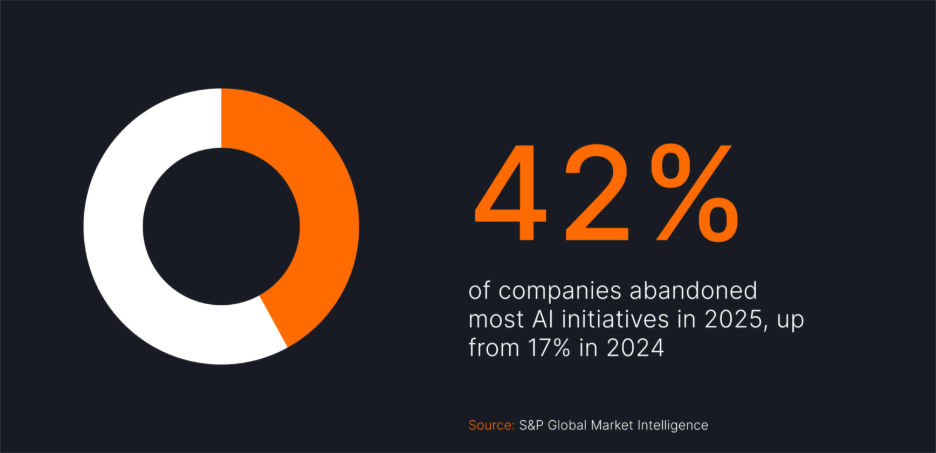
The pattern repeats across industries: coordination failures kill projects that technical capability alone can't save.
The right AI team structure increases sprint velocity by 30-40%, reduces rework cycles, and moves AI models from notebooks to production APIs in weeks instead of months.
What is an AI Team Structure?
An effective AI team structure connects data science, engineering, product, and domain experts around shared KPIs and sprint rhythms. This design enables fast iteration, reduces bottlenecks, and moves the AI model into production.
When structured correctly, your team moves from prototype to production without coordination delays. Data science feeds clean training sets to machine learning engineers. AI engineers deploy systems that product teams can actually use. Everyone knows what success looks like, and everyone ships toward the same goals.
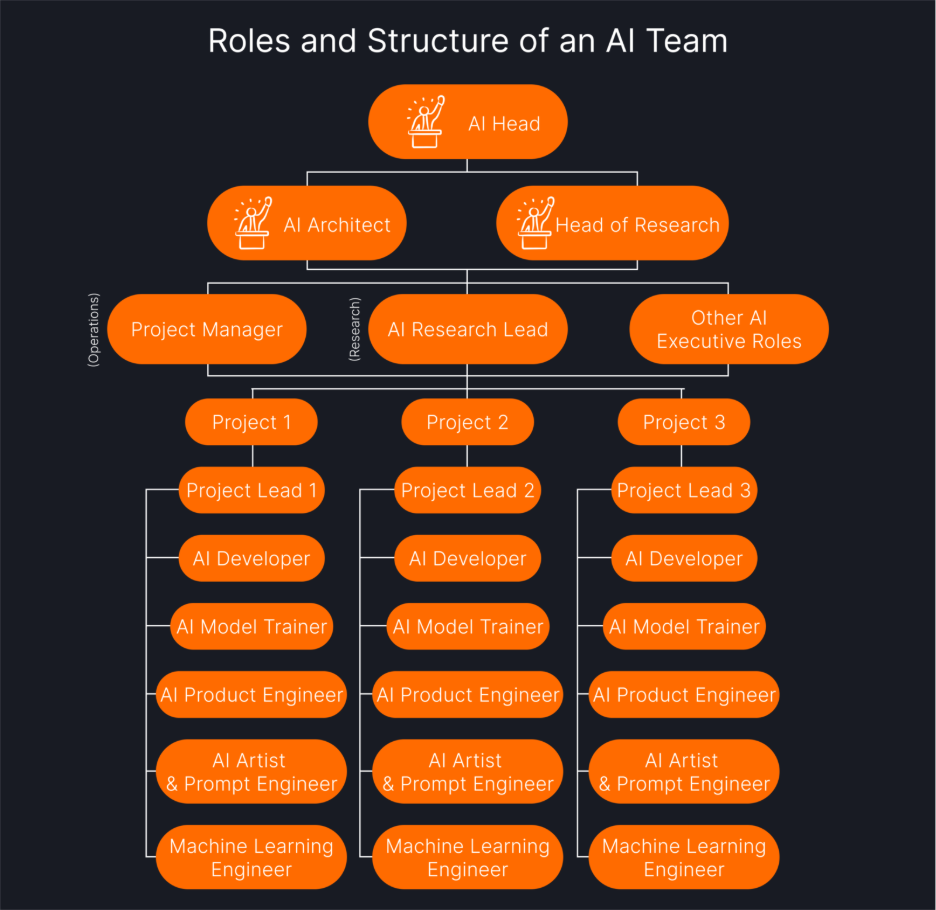
Structure turns individual skill into team velocity. Align delivery to business goals, remove handoff delays, and scale capacity sprint by sprint.
Why the Right Team Structure Matters in AI Projects
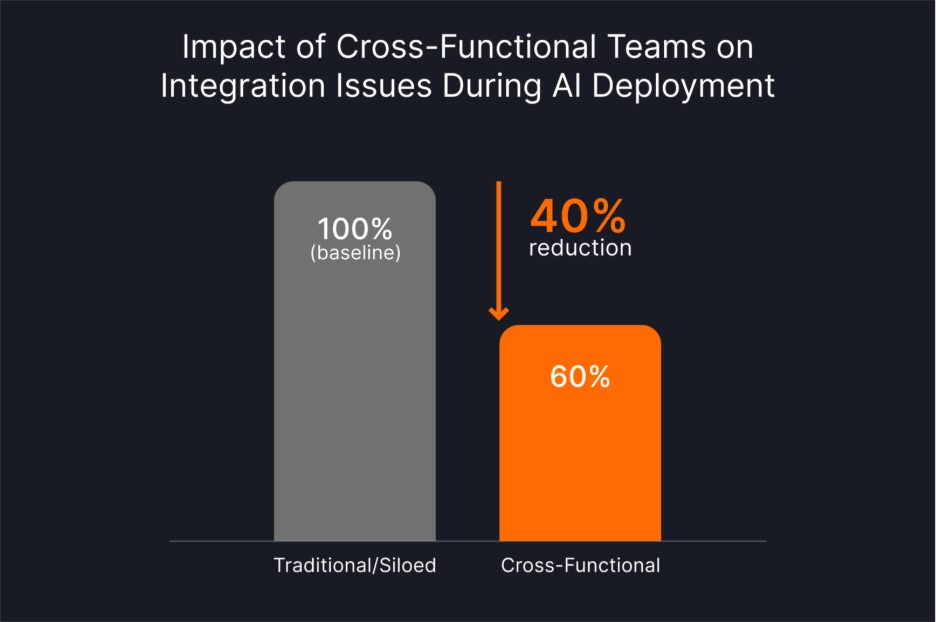
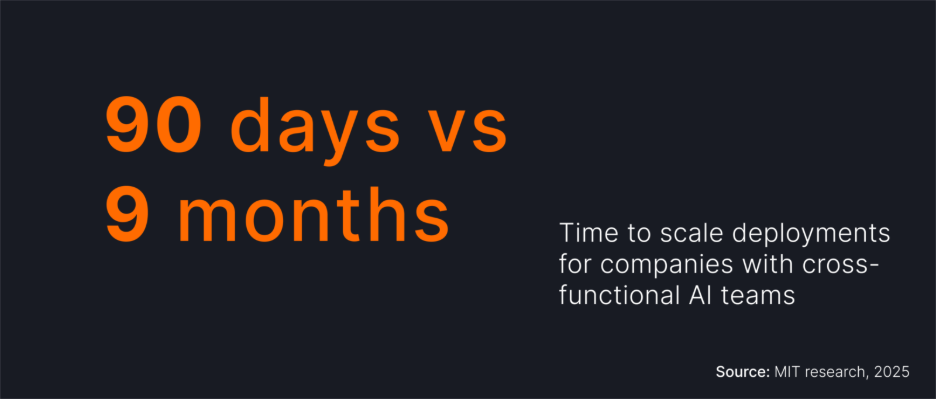
Most AI projects fail because of workflow misalignment. MIT Sloan's 2025 research on AI implementation barriers found that companies with cross-functional teams scale deployments in 90 days on average, versus nine months for enterprises with fragmented setups. The difference comes down to three factors.
- Aligned delivery. Roles map to sprint cadence. Data scientists finish feature engineering before AI engineers start model deployment. No waiting three days for a handoff. Everyone works on what matters when it matters.
- Shared accountability. Your data scientist and AI engineer co-own latency targets. Product and AI leads co-own conversion uplift. Nobody hides behind "not my metric." When something breaks or slows down, the people who can fix it are already coordinating.
- Faster scaling. Teams built for adaptation move AI initiatives from MVP to enterprise-grade systems without restructuring. You don't throw away your organizational structure when you go from pilot to production. You scale what already works.
AI Team Structure Types to Consider
No single approach fits every company. Your AI team structure depends on how fast you need to ship, whether you're building IP or integrating third-party systems, and how senior your internal AI engineers and data scientists are.
Three models dominate in practice.
Internal Team Structures
In a fully internal approach, everything runs in-house. Data scientists, machine learning engineers, backend developers, and product leads operate within the same organization. They're either fully embedded into product squads or centralized in an AI development unit. You get tight control and deep domain knowledge. You pay for it with time and cost.
This model works when you're building long-term AI initiatives tied to core IP; data sensitivity requires strict oversight, or stable infrastructure supports continuous experimentation. Internal-only structures demand heavy investment and require time to mature.
Augmented Teams
Augmentation adds speed to your AI team structure. Instead of waiting six months to hire, you embed external AI engineers who specialize in fine-tuning LLMs, deploying APIs, or building secure model pipelines. This approach works well for fast-moving pilots or MVPs, filling capability gaps in areas like NLP or computer vision, and scaling without slowing down for long hiring cycles.
External augmentation can integrate tightly with internal workflows when you adopt a hybrid outsourcing model or work with partners who align with your sprint cadence and toolstack. For growing companies, this beats months-long recruiting cycles, especially in regions facing shortages of senior data scientists and AI engineers.
You can read more on how to augment offshore staff strategically for long-term gains.
Hybrid Teams
Many successful teams blend both approaches. Core roles stay internal for ownership and stability, while augmentation provides elastic capacity. This is the model MIT's generative AI research points to when it shows external partnerships succeeding.
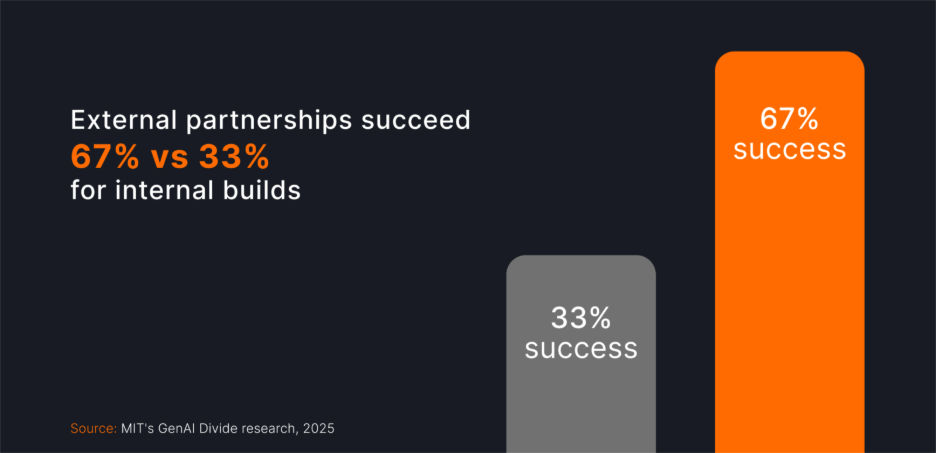
Hybrid structures capture advantages from both models. Internal data scientists anchor institutional knowledge and long-term IP development. External specialists inject rare skills on demand: fine-tuning LLMs, building computer vision pipelines, setting up MLOps frameworks. The result is a structure that adapts without overstretching internal teams.
This model tackles AI development's biggest hidden risk: dependency. Relying exclusively on internal hires creates bottlenecks when talent leaves. Over-relying on outsourcing fragments ownership and slows decision-making. Hybrid mitigates both by distributing capacity while keeping accountability clear.
Hybrid structures accelerate learning. Specialists don't just deliver features, they share domain knowledge. Internal AI engineers absorb new toolchains and domain expertise. External experts gain context they can't get in silos. Every sprint, the combined team grows stronger.
This approach works when you need to scale fast without losing IP ownership, specialized expertise is scarce or expensive to hire full-time, internal teams risk burnout from overlapping priorities, or long-term sustainability is just as important as short-term speed.
Benefits of Structuring Your AI Team Right
Your AI team structure determines how fast you ship and how well systems perform in production. When roles, ownership, and workflows align, AI initiatives move from pilots to production without rework. Structure it right, and you spend less time managing blockers. You ship outcomes.
Faster Sprint Velocity
Aligned structures cut down on handoff delays and decision latency. Instead of sprints bogged down in "who owns what," every cycle builds on shared objectives. MIT's research on AI deployment shows that companies with cross-functional teams scale deployments in 90 days on average, versus nine months for enterprises with fragmented setups.
Higher Code and Model Quality
Quality code requires two things: technical skill and team structure. When AI engineers, data scientists, and product owners collaborate from day one, you get both working together. Shared accountability reduces rework. Models are engineered for production readiness. Pipelines move from notebooks to APIs without friction. Structure shapes outcomes.
Smarter Collaboration
An effective AI team structure is designed to be cross-functional. When product managers, AI engineers, and data scientists co-own outcomes, communication becomes proactive instead of reactive. Shared KPIs and sprint rhythms help avoid friction, while cross-disciplinary feedback loops ensure business context isn't lost in translation. Well-integrated teams build better. Systems become accurate, relevant, and impactful.
Sustainable Scaling
Strong structures are built for adaptation, blending internal ownership with augmented talent to scale capacity smoothly as AI initiatives expand. MIT's analysis confirms that external partnerships double success rates compared to internal-only builds, precisely because they bring flexibility where organizations need it most. The benefits of structuring teams correctly are measurable: faster delivery, better quality, and ROI that survives the jump from pilot to production.
Conclusion
AI scales based on how talent is structured. The companies moving fastest are those that map roles directly to sprint cadence, build cross-disciplinary ownership into KPIs, and blend internal expertise with external specialists at critical points. This is the real multiplier.
With the right AI team structure, sprint velocity increases, quality improves, and time-to-production shortens dramatically. At Genius Match, our IT staff augmentation services connect companies with AI-ready senior data scientists and AI engineers who integrate seamlessly into existing teams. Our embedded model accelerates delivery without adding long-term overhead. Our AI-ready senior developers arrive equipped with tool fluency in GitHub Copilot, Claude, LangChain, and RAG architectures, and our global network ensures access to scarce machine learning expertise exactly when needed.
Whether you're moving a pilot to production, filling capability gaps in NLP or computer vision, or scaling an AI project without overstretching your internal team, Genius Match provides the embedded talent and strategic guidance to make it happen. AI initiatives move beyond pilots and deliver measurable outcomes in quarters, not years.
Frequently Asked Questions (FAQ)
How big should an AI team be?
Big enough to cover data science, engineering, and product, but no bigger than the sprint can coordinate. Many high-performing structures start with five to eight core members and scale by adding specialized talent through augmentation when needed.
Who should lead an AI development team?
A product-oriented leader with technical fluency. The best leaders bridge business goals with data science and engineering realities, ensuring sprints stay aligned to outcomes instead of just experiments.
Can agile work well with AI?
Yes, with adjustments. Agile works best when roles are explicitly mapped to sprint phases like data prep, model training, and deployment. Teams succeed when agile rituals account for experimentation as well as delivery.
Should AI teams be centralized or distributed?
Neither extreme works best. Centralized teams offer control, distributed teams move faster. The most effective structures are hybrid: a central core for governance, augmented by embedded specialists in product squads.
What's the ideal sprint length for AI teams?
Two to three weeks. Short enough to keep iteration cycles fast, long enough to capture data-to-model-to-deploy feedback loops. The key is clear goals per sprint instead of the calendar length.

What HR Media Picked Up When Geni Launched
Geni launched in September. Here is what HR and tech media wrote about it, and the hiring numbers sitting underneath the coverage.

Why fraud and application overload are the same problem - and what it takes to solve both
Recruiters have never had more applicants to choose from. They have never had less certainty about who those applicants are. We look at how volume and fraud became one problem, and what it takes to fix it at the source.
Hiring Is Getting Harder in GovCon, and Here's What It's Costing Contractors
Intro for the blog page A bad hire in GovCon doesn't cost you a salary. It costs you a CPARS rating, and CPARS follows you into the next recompete. Here's how one screening decision reaches an award you haven't bid yet.