The Humans Behind the Orchestration Layer - Why the AI era demands more skilled people, not fewer

There is a version of the AI story that goes like this: software gets smarter, teams get smaller, and companies do more with less. That version is missing the most important part.
The companies seeing real returns from AI right now are the ones who built the right teams to architect, orchestrate, and govern AI systems. The ones who cut their technical teams are learning that lesson the hard way. That difference will shape competitive outcomes for the next decade.
Orchestration Is the Work
AI orchestration is the coordination of multiple models, agents, data pipelines, APIs, and infrastructure components into a reliable, working system. It is what sits between the models your organization uses and the outcomes those models actually produce.
This work requires experienced engineers and architects who understand distributed systems, data integrity, latency trade-offs, security boundaries, and how to build for failure. The more complex the AI stack, the more those people matter.
Platform engineers decide how models connect to production systems. Data engineers determine what those models can actually see and trust. DevSecOps professionals set the guardrails that keep automated systems from causing expensive mistakes. AI/ML engineers build the feedback loops that make systems improve over time. None of this happens on its own. All of it requires human judgment.
The Talent Gap Is the Bottleneck
Most organizations understand they need to move on AI. Many are struggling to move at all. The bottleneck is rarely budget or tooling. It is the availability of people who have done this before.
The professionals who know how to build and manage AI orchestration layers are in high demand across every sector. Financial services, healthcare, manufacturing, and retail are all competing for the same pool of experienced technical talent.
Traditional full-time recruitment timelines do not match the pace of project-driven AI work.
This is where contracting has a real advantage. A senior platform engineer with AI orchestration experience, available for a six-month engagement, can get a project moving that has been stalled for a year waiting on a permanent hire. The work gets done. The organization builds internal capability alongside the engagement. The business outcome gets realized on schedule.
Right-Shore Talent for AI-Era Projects
The geography of AI talent has shifted. Strong platform engineers, ML specialists, and data architects are working across Eastern Europe, Latin America, and the US. The strategic question for organizations is how to place the right expertise in the right location for each part of a project, and that answer looks different depending on the work.
Compliance-sensitive work, stakeholder-facing systems, and real-time collaboration often point toward onshore or nearshore placement. Infrastructure and backend pipeline work, where time zone overlap matters less, can be well-served by offshore talent with deep specialization. A deliberate right-shore strategy looks at all three options and matches placement to actual project requirements.
Cost is one factor. Finding the right expertise, in the right location, for each initiative is the goal. Organizations that treat talent placement as a strategic decision will move faster on AI than those working from a single default model.
What This Means Practically
If your organization has AI initiatives on the roadmap for 2026 and 2027, the talent question deserves the same attention as the technology question. A few things worth keeping in mind:
The roles that matter most for AI orchestration, platform engineering, DevOps, data engineering, cybersecurity, and AI/ML development, are the same roles where demand has kept climbing through every round of AI hype. These professionals are harder to find than they were two years ago.
Contract-based staffing for defined AI projects gives organizations speed that permanent hiring cannot match. For the right partner with an available bench of specialized talent, first placement timelines of one to two weeks are realistic.
Right-shore placement should be a deliberate decision made at the project level. The organizations seeing the best results treat geography as a variable in their talent strategy, something they revisit for each initiative rather than something they set once.
People and talent have never been more important
AI changes how work gets done. The professionals who build, orchestrate, and secure these systems are the ones who determine whether that change creates value or just complexity. Even with all the new tooling, the recipe has not changed. Success still comes down to having the right people with the right skills on your team.
Genius Match is a talent solutions firm specializing in right-shore placement of technical and knowledge worker talent across offshore, nearshore, and onshore locations in 20+ countries.

What HR Media Picked Up When Geni Launched
Geni launched in September. Here is what HR and tech media wrote about it, and the hiring numbers sitting underneath the coverage.

Why fraud and application overload are the same problem - and what it takes to solve both
Recruiters have never had more applicants to choose from. They have never had less certainty about who those applicants are. We look at how volume and fraud became one problem, and what it takes to fix it at the source.
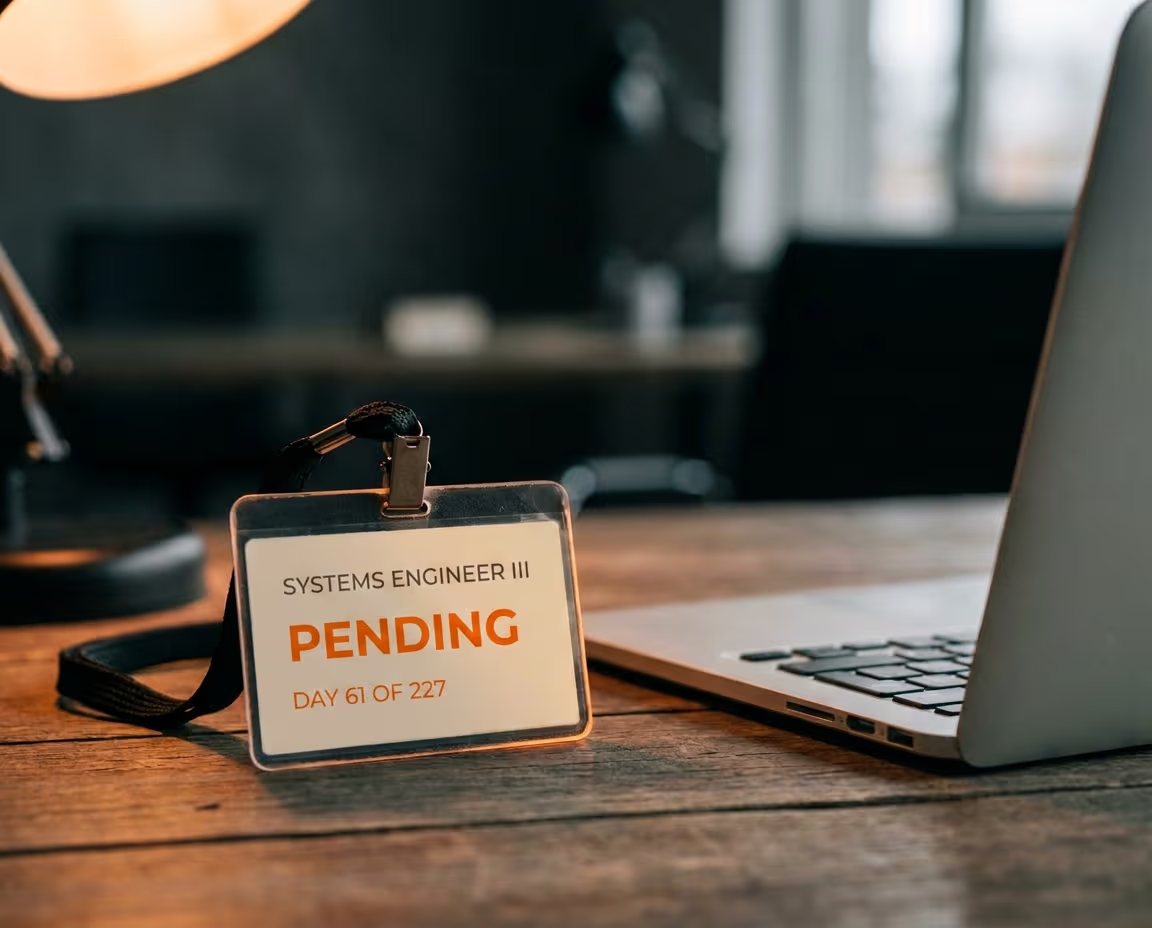
Hiring Is Getting Harder in GovCon, and Here's What It's Costing Contractors
Intro for the blog page A bad hire in GovCon doesn't cost you a salary. It costs you a CPARS rating, and CPARS follows you into the next recompete. Here's how one screening decision reaches an award you haven't bid yet.