Why fraud and application overload are the same problem - and what it takes to solve both

Hiring has quietly become one of the least trustworthy processes in business. Two forces are colliding at once: a surge in application volume that has buried recruiters in noise, and a surge in candidate fraud that has made it harder than ever to tell who is real. Together, they have created a genuine trust deficit - employers can no longer assume that a polished resume, a strong phone screen, or even a live video interview represents a real, qualified, unique human being on the other end.
This article lays out the scale of both problems, why today's hiring stack was not built to solve either of them, and how Geni closes the verification gap at the exact point where trust in hiring breaks down.
The Application Flood
The first force reshaping hiring is sheer volume. Generative AI has made it nearly effortless to apply to jobs, and job seekers have responded accordingly. LinkedIn has reported a roughly 45 percent surge in applications submitted on its platform even as the number of open postings declined - a gap driven largely by AI “apply” tools that let a single candidate blanket hundreds of roles in minutes. At peak, the platform has processed on the order of 11,000 applications per minute.
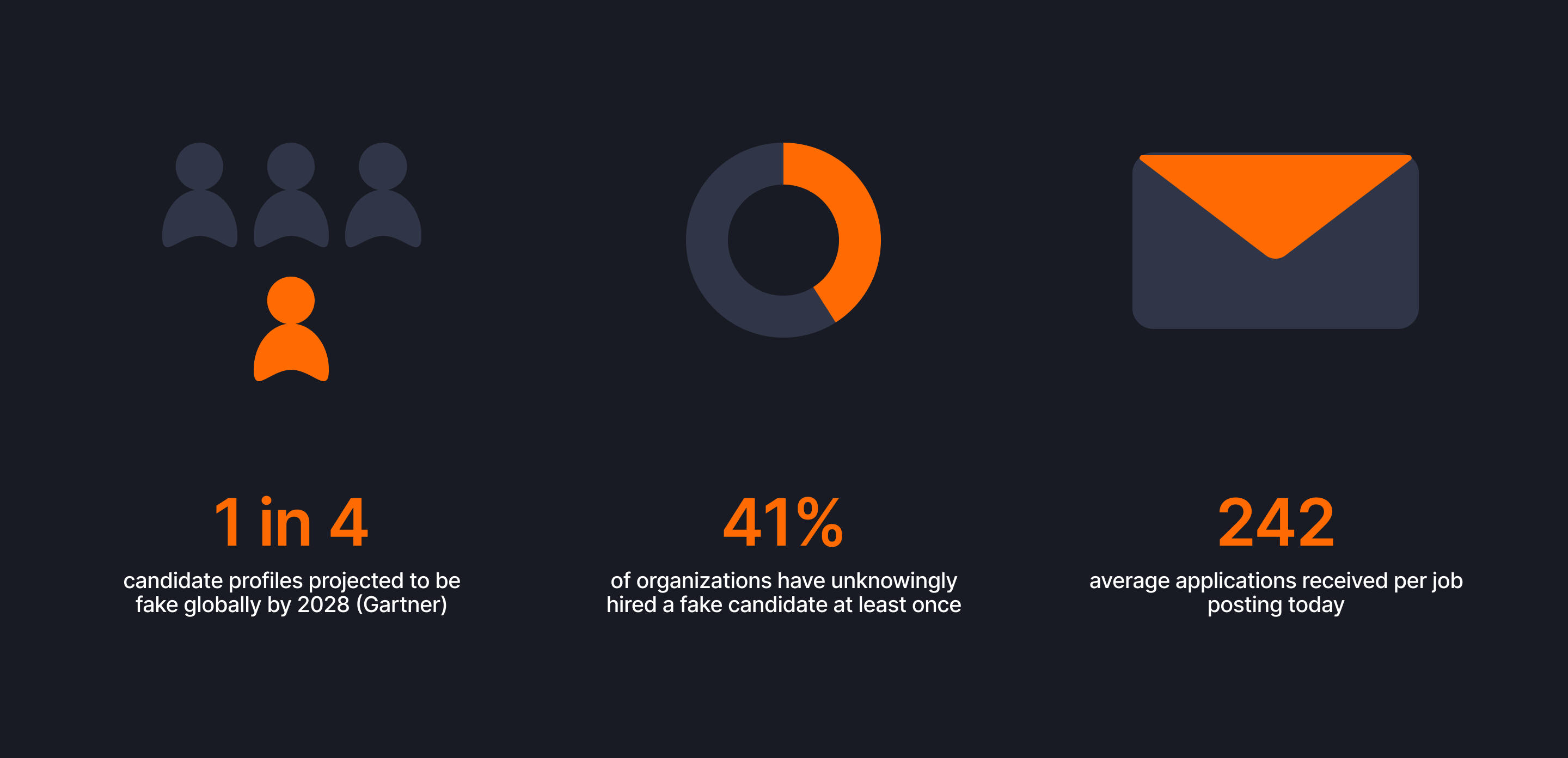
The average job posting now draws around 242 applications, and recruiting teams report processing roughly 200 applications for every single hire made. Despite widespread AI adoption on the employer side to keep pace, time-to-hire has actually gotten worse at six in ten organizations - automation is absorbing volume, not solving the underlying problem.
The deeper issue is what this flood has done to the resume as a signal. When any candidate can generate a polished, keyword-optimized application in seconds, the resume stops functioning as a useful filter.
Industry researchers now describe this as a signal-to-noise crisis: qualified, genuine candidates have not disappeared, but finding them has become dramatically harder because everything in the pipeline looks equally credible on paper.
The Fraud Layer
Underneath the volume problem sits a more corrosive one: a meaningful and growing share of that volume is not genuine at all. Gartner projects that by 2028, one in four candidate profiles worldwide will be fake or synthetic. That trend is already visible in 2026 data - 41 percent of organizations report having hired and onboarded a fake candidate at least once, and 23 percent report identity fraud specifically among new hires.
Deepfake technology has moved from novelty to routine tactic. A meaningful share of hiring managers now report encountering candidates who used deepfake tools to alter or fabricate a video interview, and a share of candidates openly admit to posing as someone else, or having someone else pose as them, during an interview. Industry surveys now rank fraudulent or AI-assisted candidates as the single largest anticipated hiring challenge of 2026 - ahead of the long-standing concern about a shortage of qualified talent.
This is not limited to entry-level or gig roles. UK talent leaders increasingly cite AI-enabled impersonation and deepfake technology as the most sophisticated emerging threat to recruitment integrity, spanning skilled and technical hiring where the stakes, and the access granted on day one, are highest.
When Volume and Fraud Collide
Volume and fraud do not operate independently - they compound each other. The same AI tools that let a genuine candidate submit a polished application in seconds let a fraudulent one do the same. As a result, recruiters have lost the qualitative cues - typos, inconsistent formatting, obviously generic language - they once used to triage quickly. The majority of hiring teams now say they regularly encounter AI-generated or AI-assisted applications, and recent industry research describes trust between candidates and employers as having effectively collapsed on both sides of the table.
Employers' response has largely been to add more human verification steps back into the process - the average number of interviews per hire has climbed sharply since 2021. That is a rational reaction, but it is also expensive: every additional interview consumes recruiter time and hiring-manager bandwidth that the original AI tooling was supposed to save in the first place.
The Security Dimension: When Fraud Becomes Infiltration
For a subset of employers - particularly in fintech, crypto, cybersecurity, government contracting, and other remote-friendly technical roles - candidate fraud escalates from a hiring-quality problem into a national-security and sanctions problem. The best-documented example is the DPRK IT worker scheme: an estimated 100,000-plus North Korean nationals, operating under fabricated identities across dozens of countries, generating on the order of half a billion dollars a year for the North Korean regime, with individual operatives reportedly able to earn up to $300,000 annually while the regime retains the large majority of that income.
Generative AI has made this scheme dramatically harder to catch. Threat researchers have documented DPRK operators using AI to write tailored résumés, script interview answers in real time, and translate communications convincingly enough to defeat the informal cultural and linguistic cues that used to raise red flags. A related scheme, sometimes called “Contagious Interview,” flips the funnel entirely - posing as recruiters to trick real candidates into installing malware during a fake technical interview.
The legal exposure here does not stop at the worker. Companies that unknowingly pay a sanctioned individual bear sanctions risk themselves, and federal indictments have already targeted U.S.-based facilitators who laundered paychecks and ran so-called “laptop farms” to make overseas operatives appear domestically employed. Once inside a company, these operatives have also been linked to data theft, intellectual property theft, and extortion attempts.
This is the throughline that matters most for hiring leaders: what looks like a talent-acquisition problem (an unusually persuasive but slightly-off candidate) and what looks like a security problem (an unauthorized actor inside company systems) are frequently the exact same funnel, viewed from two different parts of the org chart.
What It Costs to Get It Wrong
The financial case for closing this gap is not abstract. A bad hire is conservatively estimated at 30 to 50 percent of that employee's first-year salary once recruiting, onboarding, lost productivity, and replacement costs are included, with the average cost to replace an employee reaching roughly $56,500 in 2026 benchmarks; some analyses put the fully-loaded cost several times higher.
When the “bad hire” is also a fraud, an identity-theft victim's stolen credentials, or a sanctioned foreign operative, those costs compound with legal exposure, breach response, and reputational damage that a standard cost-per-hire model was never built to capture.
Why the Existing Hiring Stack Can't Close the Gap
Applicant tracking systems were designed to organize and route applicants, not to evaluate whether the person behind an application is who and what they claim to be. Resume screening, whether manual or AI-assisted, is now working from a document format that generative AI has fully commoditized. And live video interviews - long considered the trust-restoring step after a resume screen - are themselves vulnerable to the same deepfake tooling driving the fraud numbers above.
Most of the market has responded by treating volume management and fraud detection as two separate problems, solved by two separate categories of tool. In practice they are one problem: verifying, at the scale modern application volume demands, that the person behind the profile is real, is who they claim to be, and can do what they claim they can do.
Closing the Verification Gap: How Geni Solves It
Geni was built around a simple premise: the fix for both the volume crisis and the fraud crisis is the same fix, applied at the top of the funnel. Rather than parsing resumes for keywords, Geni conducts a structured, AI-powered conversation with every candidate - verifying identity and authenticity directly, rather than inferring it from a document that is trivially easy to fabricate.
- Turns volume into signal: Geni absorbs the full flood of inbound applications and returns a small set of verified, high-fit candidates - solving the noise problem and the fraud problem in the same step, because verification is the filter.
- Speaks to both halves of the organization: the same authenticity check that stops a TA team from advancing a deepfaked or AI-cheating candidate is the check that stops a security team's worst-case scenario - a DPRK-style infiltration or sanctioned operative - from ever reaching an offer.
- Preserves candidate experience: verification does not have to mean a colder, more adversarial process for genuine candidates - Geni's conversational approach is built so nobody gets ghosted, even as scrutiny goes up.
- Builds a defensible record: every conversation produces a searchable, auditable trail that supports compliance, bias-audit, and legal-defensibility needs - turning verification into documentation, not just a gut check.
The market has spent the last two years fighting volume and fraud as if they were separate fires. They are the same fire. Geni is built to put it out at the source - the moment a candidate first enters the funnel - rather than trying to catch what slips through with more interviews, more tools, and more manual review downstream.
Conclusion
Hiring today has more applicants than ever, and less certainty than ever about who they really are. Application volume and candidate fraud are not two problems for two point solutions - they are one problem with a single point of failure: the absence of real identity and authenticity verification at the top of the funnel.
Verification is no longer a nice-to-have bolted onto the hiring process. It is the missing layer between the modern application flood and a hiring decision an organization can actually trust. That is the gap Geni exists to close.

What HR Media Picked Up When Geni Launched
Geni launched in September. Here is what HR and tech media wrote about it, and the hiring numbers sitting underneath the coverage.
Hiring Is Getting Harder in GovCon, and Here's What It's Costing Contractors
Intro for the blog page A bad hire in GovCon doesn't cost you a salary. It costs you a CPARS rating, and CPARS follows you into the next recompete. Here's how one screening decision reaches an award you haven't bid yet.
