Hiring Is Getting Harder in GovCon, and Here's What It's Costing Contractors
By Shaun Poulton, Chief Technology and Product Officer, Genius Match & Geni
Three weeks into a new task order, a program manager finds out the systems engineer who interviewed well can't do the work. The deliverable date hasn't moved. The team scrambles to cover a gap that shouldn't exist this early in a contract built to run for years, and the customer's first impression is already a bad one.
Sometimes the seat just sits empty through transition, with no one in it at all, while the same deliverable date and the same SLA clock keep running. Now the company is out of compliance with the staffing plan and labor categories it proposed and priced, and if it's a key personnel position, the contracting officer gets involved in approving a substitute.
Both scenarios keep happening across the industry, and the causes run wider than any one bad screening decision.
Fewer experienced people, on both sides of the table
More than 28% of full-time permanent federal employees were 55 or older as of September 2024, per Office of Personnel Management data, and the average federal worker is about 5 years older than the median for the US labor force.
Every retirement on the government side takes program knowledge out the door. On the contractor side, the same generation holds many of the certifications, clearances, and program histories that fill senior labor categories. Competition on procurements keeps tightening while the pool of people who can staff them keeps shrinking.
Contracts move fast once won, hiring doesn't
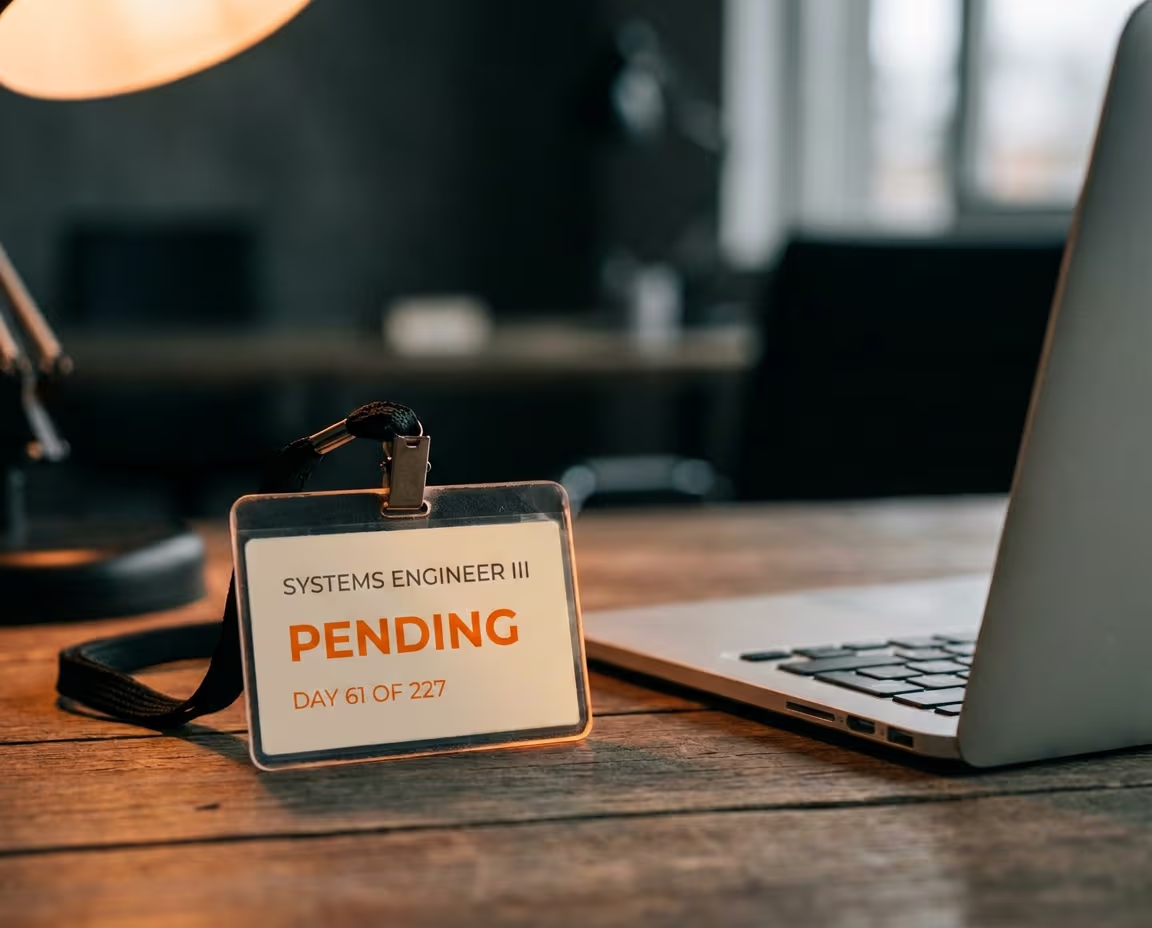
An award can require a full team in the seats within a 30 to 60 day transition window. Cleared and specialized labor categories don't fill on that clock. The latest DCSA industry figures put Secret clearance processing at 156 days and Top Secret at 227 days for the fastest 90% of cases, and that's after years of backlog reduction.
Compensation adds another squeeze. The hottest labor categories are resetting market pay mid-contract, so a company wins a bid at one rate and pays a different one by the time the seat is filled. The gap gets covered with expensive backfill or subcontractor premiums, and margin lost that way rarely comes back over the life of the contract.
Funding nobody can plan around
Congress has not enacted all 12 appropriations bills on time since fiscal 1997, and over the past 28 fiscal years, interim continuing resolutions have covered an average of about 4 months per year, per the Congressional Research Service. For contractors that means being ready to scale a team up or down on short notice, a harder problem than finding people, because carrying the bench that makes it possible is expensive.
The applicant pool grew and got less honest at the same time
AI has made it nearly effortless to apply to dozens of roles at once, with a resume and cover letter tailored to each posting in seconds. LinkedIn has reported a 45% year-over-year surge in applications submitted on its platform. Gartner projects that by 2028, 1 in 4 candidate profiles worldwide will be fake. And this has already reached sensitive work: the Department of Justice has prosecuted schemes that placed North Korean IT workers into more than 300 US companies under stolen identities.
When a resume can be generated to match any job description perfectly, the resume stops telling a recruiter much of anything. In an industry where roles carry clearance requirements and access to sensitive systems, that's a security problem as much as a hiring problem.
What a bad screen costs in this industry
Government contractors run full background investigations before anyone starts, so most fraud and misrepresentation does get caught eventually. By then, weeks of interviews, paperwork, and investigation costs have gone into someone who was never going to pass.
A bad hire that gets further shows up as turnover or poor performance, and those land in CPARS ratings and SLA numbers, the same records that follow a company into its next recompete and its next pursuit. Unfilled positions during transition do the same damage, sometimes worse. Cost of hire climbs. Workshare inside teaming agreements can shift too, because partners notice which companies staff reliably and which ones create risk for the team.
Candidates notice as well. A slow process, or a company that ghosts people, loses standing in a cleared talent pool small enough to remember who moved fast and treated them with respect.
A live conversation is harder to fake
AI can produce a polished application in seconds. A live, adaptive conversation about work someone did is much harder to fake, and that is why we built Geni.
Every applicant using Geni gets a 12-minute adaptive interview built around the experience on their own resume, so the questions get specific in the places where a generic answer may otherwise be ok. Consistency under that kind of real-time questioning feeds an evidence-based score against clear criteria. The recruiter gets that score for every candidate, plus a separate advisory flag on anything worth a closer look. The two stay separate on purpose: authenticity signals never feed into or bias the score, and an honest gap in someone's background is never a flag.
A human makes the call in every case. Geni surfaces evidence and flags patterns for review, and it never rejects a candidate on its own.
For a contractor, that pulls the discovery of a misrepresentation forward by weeks, before interview hours, paperwork, and investigation costs have gone into the wrong person. It gives recruiters a defensible basis for fit instead of a guess, which cuts the turnover that lands in CPARS ratings and SLA numbers. It lowers cost of hire, protects standing inside teaming agreements, and keeps the process fast and transparent enough that candidates remember it for the right reasons.
We built Geni to solve our own hiring problem first. Genius Match has spent 15+ years placing technical talent, which is how we knew exactly where hiring breaks in this industry, and Geni still runs on our own live placements. When a score is wrong, it costs us a real client relationship.
Try Geni yourself, or book a demo and we will run it against one of your own labor categories. Both start at geni.geniusmatch.com.

Why fraud and application overload are the same problem - and what it takes to solve both
Recruiters have never had more applicants to choose from. They have never had less certainty about who those applicants are. We look at how volume and fraud became one problem, and what it takes to fix it at the source.


The Humans Behind the Orchestration Layer - Why the AI era demands more skilled people, not fewer
Everyone talks about AI tools. Nobody talks about who actually builds the systems behind them. We look at the roles driving real AI outcomes and why the talent gap is widening.