Genius Match + Regent Education: A Partnership for Development Success

The Mission: Accelerate the Development of Next-Generation Financial Aid Software
Regent Education had a mission: create the next generation of enterprise-grade SaaS for financial aid management that would transform how U.S. higher education institutions handle the complex financial aid lifecycle. From eligibility determination to packaging and disbursement, their platform needed to automate critical processes while maintaining strict compliance with Title IV and FERPA regulations.
Building sophisticated financial aid software requires deep expertise in regulatory frameworks, complex business logic, and the ability to scale across thousands of institutions with millions of students. And doing so requires additional capacity.
Yet as many technology companies discovered, traditional outsourcing proved both costly and problematic. Resource turnover made it challenging to build and retain expertise, while significant quality issues threatened -ambitious timelines.
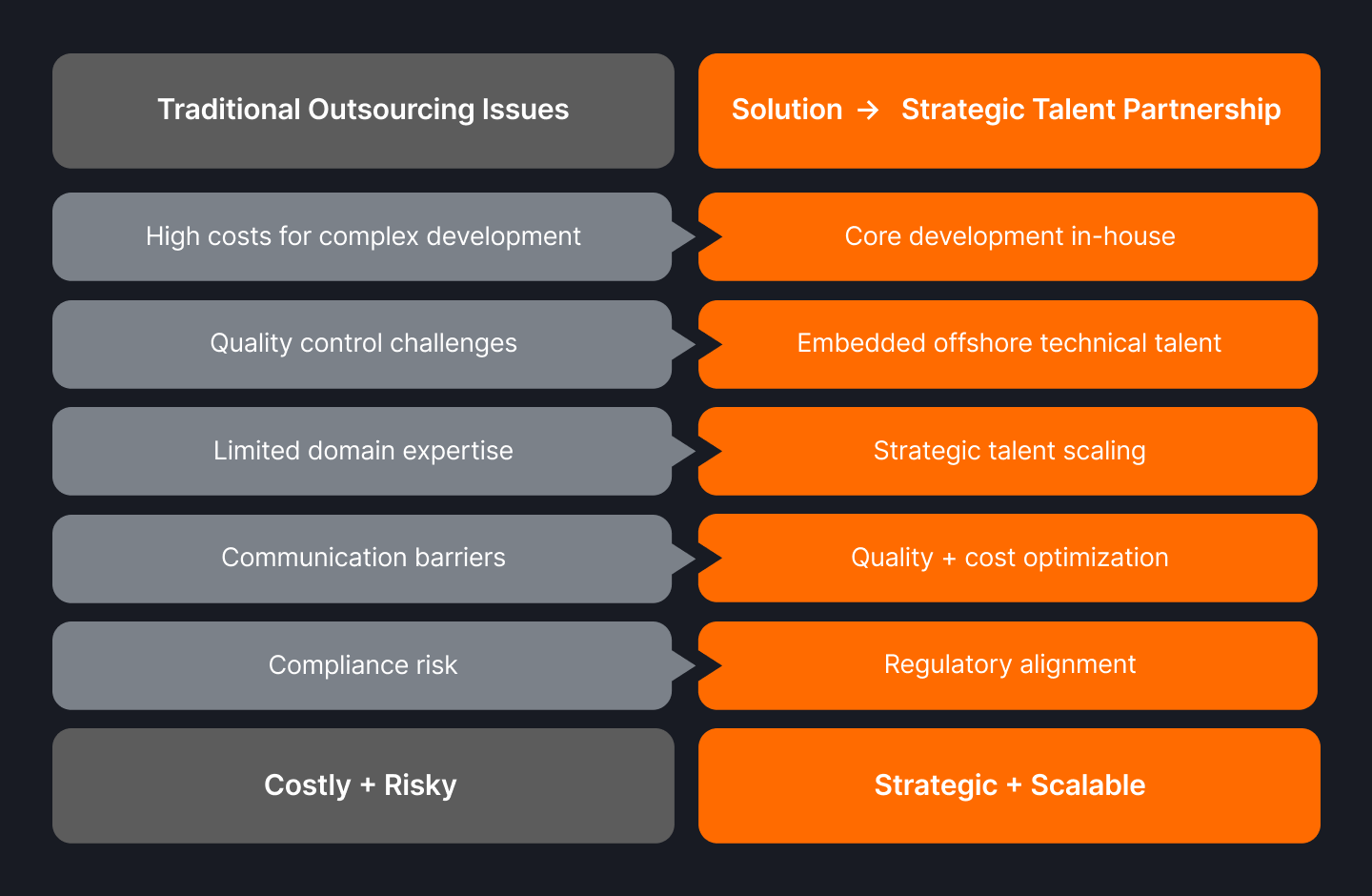
The Strategic Pivot: Extend In-House Development Expertise with Embedded Technical Resources
Rather than exploring the costly and risky path of full product outsourcing, Regent made a pivotal decision in 2010. They brought core development and management completely in-house while partnering with Genius Match to extend their team’s technical capacity using offshore software development.
This wasn't about replacing an in-house developer with an outsourced one. This was about fundamentally changing how Regent scaled their team capacity. Instead of outsourcing entire product development cycles, Regent would maintain control of architecture, product decisions, and quality standards while leveraging embedded offshore engineers who became true extensions of their internal development teams.
The difference was profound. Regent's internal leadership could focus on product strategy, regulatory compliance, and customer needs while Genius Match provided the additional capacity needed to execute their vision at scale.
The Embedded Model in Action
The embedded approach meant Genius Match engineers weren't isolated contractors working from requirements documents. They became integral parts of Regent's development organization, participating in daily standups, sprint planning, architectural discussions, and long-term roadmap planning. They received the same training as in-house resources, which included a deep-dive into the nuances of the U.S. financial aid landscape.
Key aspects of the embedded model included:

Integrated Development Process
Genius Match engineers worked alongside Regent's internal team members, sharing the same communication channels, development tools, and quality standards which helped them to operate as one unified development organization.

Regulatory Expertise Development
Through ongoing training conducted by Regent Education’s team of financial aid experts, embedded team members developed a deep understanding of the complex regulatory environment governing financial aid software. This domain knowledge became invaluable, helping them to anticipate compliance implications of technical decisions.
.png)
Institutional Knowledge Retention
Unlike traditional outsourcing where knowledge walks out the door with each contract change, the embedded model created a stable foundation of resources with institutional knowledge that grew stronger over time.
.png)
Outcome Ownership
Embedded engineers took responsibility for long-term product outcomes, not just task completion which proved crucial for maintaining quality and meeting ambitious development timelines.
The embedded model has delivered exceptional results that speak to both operational efficiency and strategic value creation.
- Team Stability and Knowledge Retention
After 15 years of continuous collaboration, the partnership has achieved a remarkable 90% team retention rate, with engineers averaging eight years of tenure on the Regent platform. This stability has created an invaluable repository of institutional knowledge with both the technical platform and the complex regulatory environment it operates within.
- Operational Performance
The partnership has enabled faster roadmap delivery with fewer missed cycles, dramatically improving Regent's ability to respond to market demands and regulatory changes. The embedded model's focus on quality has reduced technical debt and maintenance overhead, allowing the team to focus on innovation rather than firefighting.
- Business Impact
Regent customers report 60-70% ROI improvements when using the platform, a testament to the sophisticated automation and reliability that the embedded development approach has enabled. The platform's ability to handle complex financial aid scenarios while maintaining compliance has become a significant competitive advantage.
- Strategic Enablement
Perhaps most important, the embedded model has created a compliance-driven delivery framework that aligns with enterprise standards while maintaining the agility needed for continuous innovation. This has positioned Regent as a trusted partner for large-scale digital transformation in higher education.

Platform Evolution and Innovation

The true test of any long-term technology partnership comes during major platform transitions and architectural shifts. Over the past 15 years, Regent has successfully navigated multiple technology evolutions while maintaining service reliability and continuing to deliver new capabilities.
.png)
The embedded team has supported Regent through cloud migration initiatives, microservices architecture adoption, and the integration of modern development practices like DevOps and continuous integration. Each transition has been executed with minimal disruption to end customers, an achievement that reflects both the team's deep platform knowledge and their commitment to operational excellence.
.png)
Recent innovation initiatives have included the development of predictive analytics capabilities, mobile-first user interfaces, and API-driven integration architectures that position Regent's platform for the next generation of financial aid requirements.
Looking Forward: The Next Generation
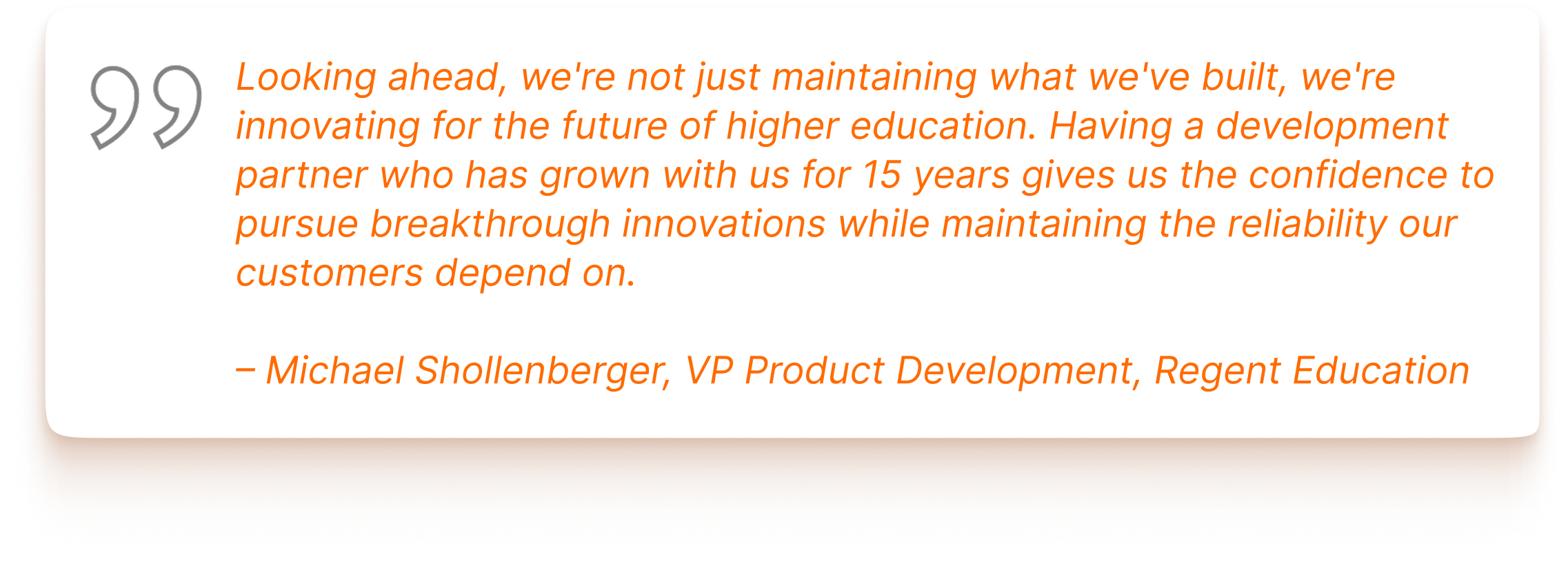
As Regent continues to evolve their platform to meet the changing needs of higher education, the embedded partnership model provides the stability, scalability, and expertise needed to pursue ambitious innovation initiatives.
Current areas of focus include artificial intelligence applications for financial aid optimization, advanced data analytics for institutional planning, and next-generation user experiences that serve the digital-native students of today.
The partnership's longevity has created a unique competitive advantage: a development organization that combines the cost efficiency of global talent with the domain expertise and institutional knowledge typically found only in long-tenured internal teams.
The Strategic Talent Partnership Model
The success of the Regent-Genius Match partnership offers valuable lessons for organizations looking to scale technical capabilities while maintaining quality and institutional knowledge.
Key Success Factors:
The embedded model
works because it aligns resources to long-term outcomes rather than short-term deliverables. Genius Match engineers are invested in the platform's success because they've been part of its evolution from the beginning.
Cultural integration
proves more important than pure technical skills. The most successful embedded engineers are those who embrace Regent's customer-focused culture and understand the mission-critical nature of financial aid processing in higher education.
Domain expertise
development takes time but creates lasting competitive advantage. The regulatory knowledge and platform understanding that embedded team members have developed through training and collaboration with the Regent Education team cannot be replicated by traditional consulting engagements or short-term contractor relationships.
Conclusion: Beyond Traditional Outsourcing
Fifteen years after making the strategic decision to bring core development in-house while partnering with Genius Match for embedded offshore development resources, Regent Education has built more than just a successful platform. They've created a sustainable competitive advantage in the complex world of EdTech.
- The embedded model has proven that organizations don't have to choose between cost efficiency and quality, global talent access and institutional knowledge retention, or scaling quickly and maintaining standards. The right strategic partnership can deliver all these outcomes simultaneously.
For Regent, the decision to augment their team with embedded resources has enabled them to build next-generation financial aid software that serves millions of students while maintaining the regulatory compliance and operational reliability that higher education institutions require.
The partnership continues to evolve, but the foundation remains solid: embedded collaboration, domain expertise development, and a shared commitment to outcomes that matter.

What HR Media Picked Up When Geni Launched
Geni launched in September. Here is what HR and tech media wrote about it, and the hiring numbers sitting underneath the coverage.

Why fraud and application overload are the same problem - and what it takes to solve both
Recruiters have never had more applicants to choose from. They have never had less certainty about who those applicants are. We look at how volume and fraud became one problem, and what it takes to fix it at the source.

Hiring Is Getting Harder in GovCon, and Here's What It's Costing Contractors
Intro for the blog page A bad hire in GovCon doesn't cost you a salary. It costs you a CPARS rating, and CPARS follows you into the next recompete. Here's how one screening decision reaches an award you haven't bid yet.