Beyond Borders - Strategic Talent Deployment for 2026

The tech sector added over 900,000 jobs in 2025, yet 87% of tech leaders still can't find the talent they need. That shortage is killing delivery velocity and stalling AI adoption across the board. The numbers tell the story: 1.6 million AI and software development positions remain unfilled globally, and the IT skills gap could cost $5.5 trillion by 2026. For engineering leaders, this means roadmap delays and competitors pulling ahead while you're still trying to hire.
Traditional hiring takes 2-3 months on average. Your product roadmap, market window, and competitors won't wait. A three-month delay means a missed sprint, slipping quarterly targets, and annual goals you won't hit.
Leading companies stopped fighting for scarce local talent. They're deploying contractor teams in days through strategic staff augmentation. Senior engineers embed long-term in product teams, delivering production work on flexible terms while staying on the provider's payroll. Quality and continuity stay intact. Hiring overhead disappears.
After nearly 20 years helping tech leaders scale teams across 20+ countries in offshore and nearshore markets, we've seen which approaches still work and which are obsolete. Here's what tech talent deployment looks like in 2026, and how leading companies stay ahead.
Trend 1: AI-Powered Talent Matching Accelerates Resource Deployment
AI-powered talent matching is no longer experimental. By 2030, 94% of tech staffing will incorporate AI assessment tools for skill verification, contractor matching, and predictive analytics. Companies using these tools see 30-40% reductions in time-to-deploy. That time saved directly reduces cost-of-delay on critical roadmap items.
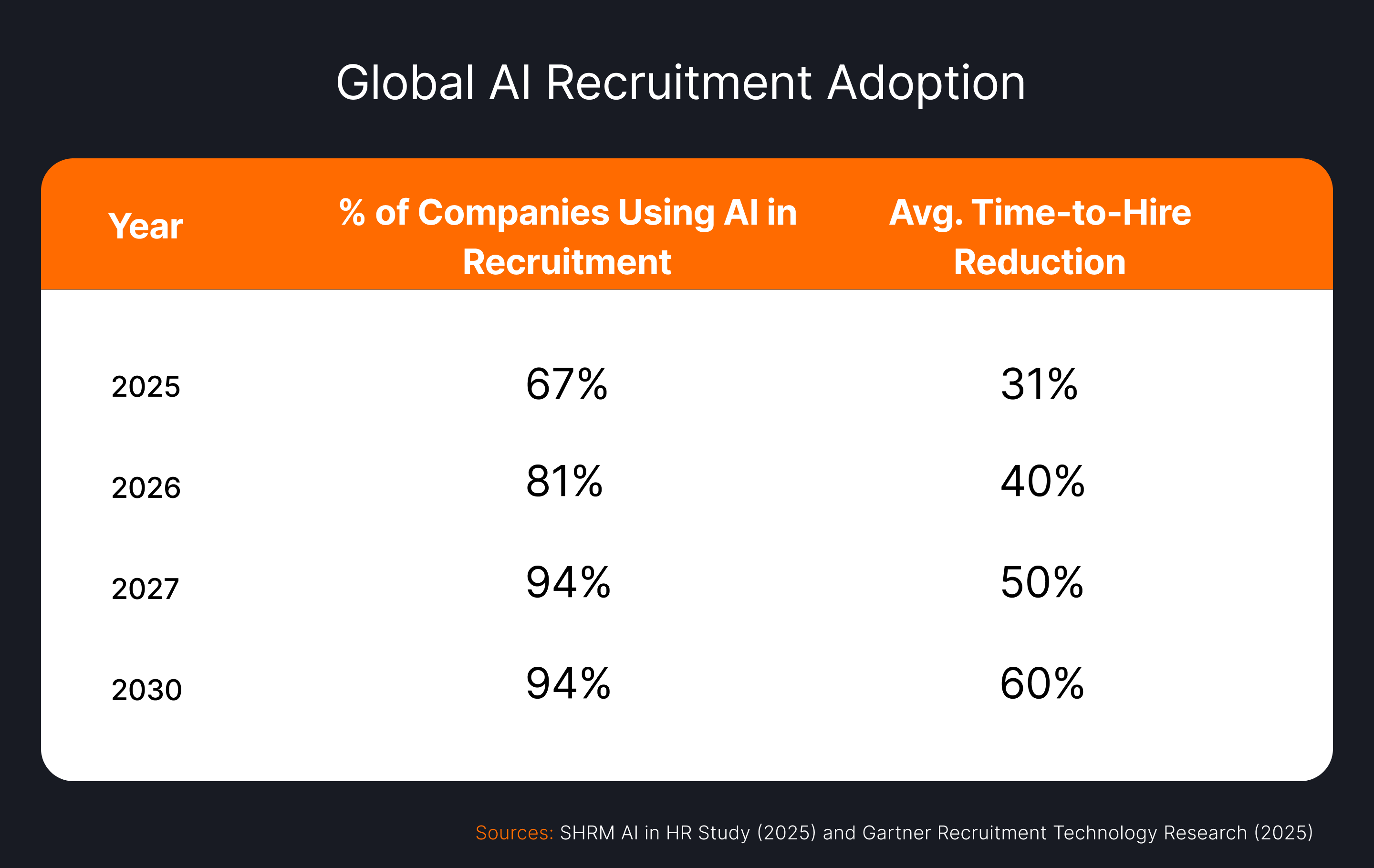
AI still doesn't solve the hardest part: securing senior engineers fast enough to impact delivery. AI specialist roles take 89 days to fill through traditional hiring, even with automation. The algorithms can screen resumes and assess technical skills, but they can't evaluate culture fit, technical depth in context, or how someone will perform in your specific team dynamics.
Hybrid AI plus expert vetting models outperform pure automation. The real advantage goes to companies working with staff augmentation partners who've already built AI-powered contractor pipelines. These partners deliver pre-vetted talent faster while maintaining quality through human oversight. With generative AI skills up 300% since 2022, speed matters.
Providers like Genius Match with long-term global contractor networks bring vetted senior talent ready to integrate immediately, not in three months.
Trend 2: Skills-Based Contractor Selection Delivers Better Outcomes
Skills-based evaluation is replacing credential requirements in contractor selection. 87% of companies now prioritize demonstrated skills over formal degrees when engaging technical contractors. Google, Apple, and IBM have dropped degree requirements for many roles. The results speak: companies report 45% increases in contractor diversity and 35% improvements in retention for skills-based engagements.
The math is simple. Dropping degree walls opens access to a contractor talent pool roughly 10 times larger, filled with bootcamp graduates, certification holders, and self-taught developers who bring practical skills without inflated rates.

International markets shine here. Eastern European contractors with hands-on portfolios often outperform degree-holding candidates with limited real-world experience. They've built production systems, solved actual problems, and command rates 40-60% below domestic equivalents. Skills matter more than pedigree.
Offshore and nearshore markets prove it daily, which is why Eastern Europe remains one of our strongest engineering contractor pools.
Trend 3: Global Contractor Networks - Distributed Teams, Aligned Delivery
Distributed contractor teams are the default now. 87% of tech companies engage global contractors for remote positions, expanding talent pools by 5x with 23% better retention than location-restricted staffing. Resist this shift and you lose access to 95% of global tech talent.
Nearshore engagement is surging. 80% of North American businesses are actively considering nearshoring because time zones align. Latin American contractors work your hours, attend your standups, and cost 40-60% less than US equivalents. 65% of tech leaders are increasing contract talent use to capture exactly this.
Eastern Europe offers deeper savings at $25-65/hour with 6-8x contractor pool expansion. The tradeoff is minimal time zone overlap (0-20%) and async collaboration. Smart companies blend both: offshore for execution, nearshore for collaboration.
Nearshore contractors cost 40-60% less than US equivalents while working your hours. You get real-time standups and same-timezone delivery without sacrificing quality.
The play: nearshore for collaboration-heavy work, offshore for scaled execution and 24/7 coverage. Leading companies match contractor location to project needs. That's the most cost-efficient approach for 2026.
Trend 4: From Temporary Fix to Strategic Contractor Partnerships
The global IT staff augmentation market is projected to hit $857.2 billion by 2031, growing at 13.2% annually. The growth signal is clear: temporary placements and recruiting services are giving way to strategic contractor partnerships that deliver continuous engineering capacity without permanent hiring overhead.
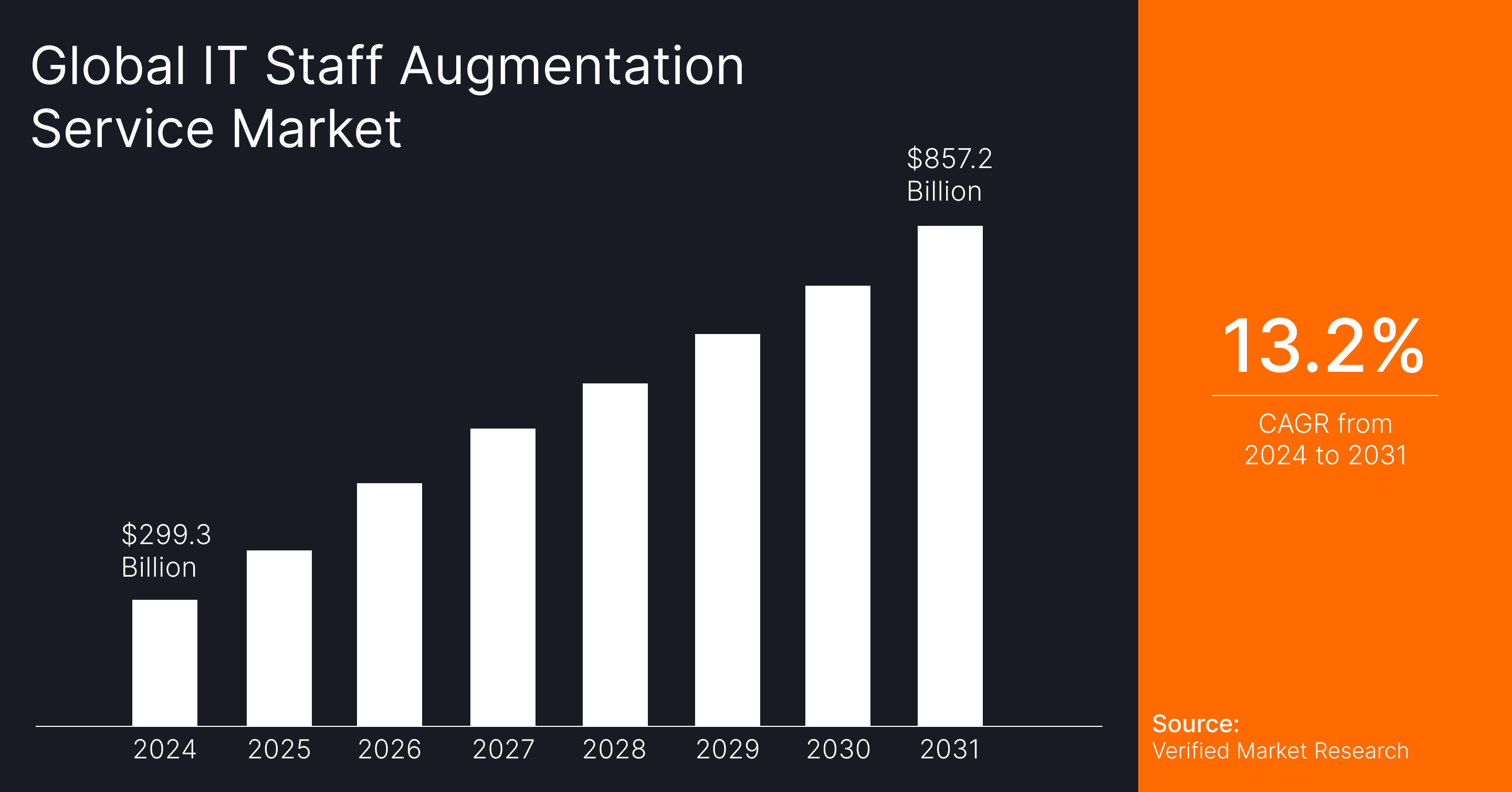
Companies are moving beyond transactional staffing toward embedded contractor teams that function as seamless extensions of internal engineering organizations. These contractors work on time and materials basis, providing flexibility to scale resources up or down while maintaining delivery continuity.
The driver is measurable: 64% of emerging technologies face adoption challenges due to skill gaps, and permanent hiring cycles take 5 weeks on average. One missed role often delays feature delivery by 1-2 sprints. That timeline doesn't work when your competitor ships every week.
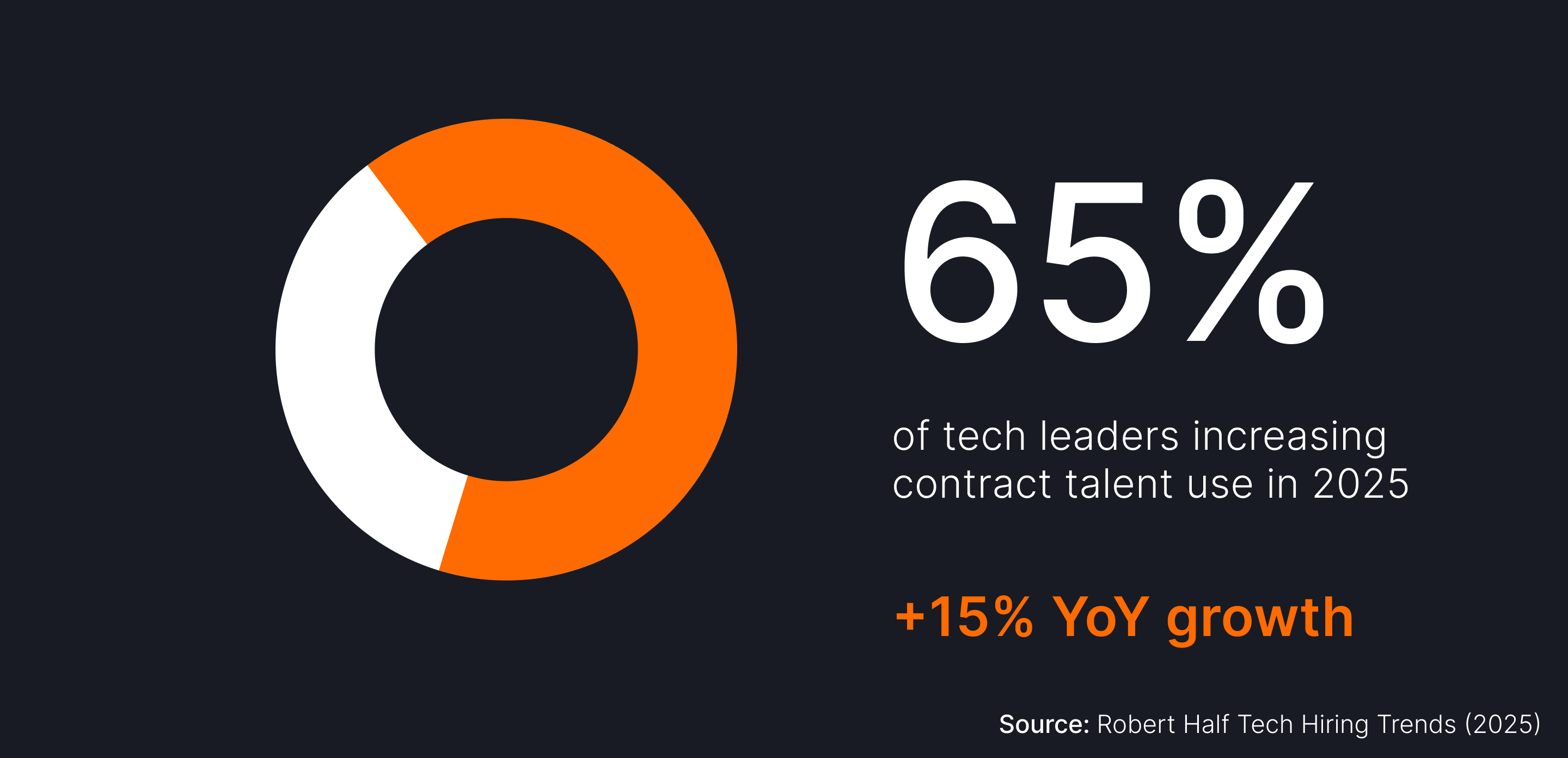
Performance-based contractor models are replacing hour-logging arrangements. This approach builds institutional knowledge while preserving flexibility. Embedded contractors learn your codebase and culture without the overhead of permanent headcount. Long-term embedded engineering contractor teams routinely maintain 90%+ retention, enabling compounding institutional knowledge.
Companies that treat their staffing partners as long-term collaborators (as seen in 10-15 year embedded contractor partnerships with customers at Genius Match) consistently outperform those relying on transactional placement vendors.
The difference shows up in velocity, quality, and total cost of ownership.
Global Contractor Partnerships Define 2026 Success
The 2026 staffing landscape runs on three shifts: AI-driven matching that cuts contractor deployment time, skills-based evaluation that unlocks global talent pools, and distributed teams as default rather than exception. Companies adopting these models now move faster and spend less. Companies waiting fall behind.
With $5.5 trillion in projected IT skills shortage losses by 2026, offshore and nearshore staff augmentation stopped being about cost savings. Now it's about staying competitive.
Picking the right partner matters. Not all staffing firms are built the same. The weak ones place bodies and disappear. The strong ones bring strategic guidance on team structure and delivery models. They embed vetted contractors who actually integrate with your culture. They handle enterprise-grade compliance without killing flexibility.
The best partners build for retention and long-term performance, not transactional placements. You can measure this: contractor tenure rates, multi-year embedded teams, and consistent delivery across complex industries like FinTech and SaaS.
Your 2026 advantage comes from contractor partnerships built for strategic thinking and sustained delivery. Choose partners who prove it with results, not pitch decks.
About Genius Match
Genius Match delivers senior engineering contractors who embed directly into your team to accelerate delivery and scale growth. We handle the engineering services. You get the outcomes.
Our contractors stay on our team while working seamlessly with yours. We manage the compliance, retention, and global contractor logistics across 20+ countries. You focus on building.
Founded in 2008 and led by former CTOs and VPs of Engineering, we know what technical leaders actually need: skilled people who show up, deliver, and stick around. Our contractors work on a time and materials basis, giving you flexibility without sacrificing continuity. They stay embedded long-term, averaging 7+ years of tenure, which builds deep domain knowledge and predictable delivery without the overhead of permanent headcount.
This staff augmentation model has powered multi-year partnerships in EdTech, FinTech, and SaaS with 100% client retention. When companies need engineering capacity that scales without the chaos, they work with us.

What HR Media Picked Up When Geni Launched
Geni launched in September. Here is what HR and tech media wrote about it, and the hiring numbers sitting underneath the coverage.

Why fraud and application overload are the same problem - and what it takes to solve both
Recruiters have never had more applicants to choose from. They have never had less certainty about who those applicants are. We look at how volume and fraud became one problem, and what it takes to fix it at the source.
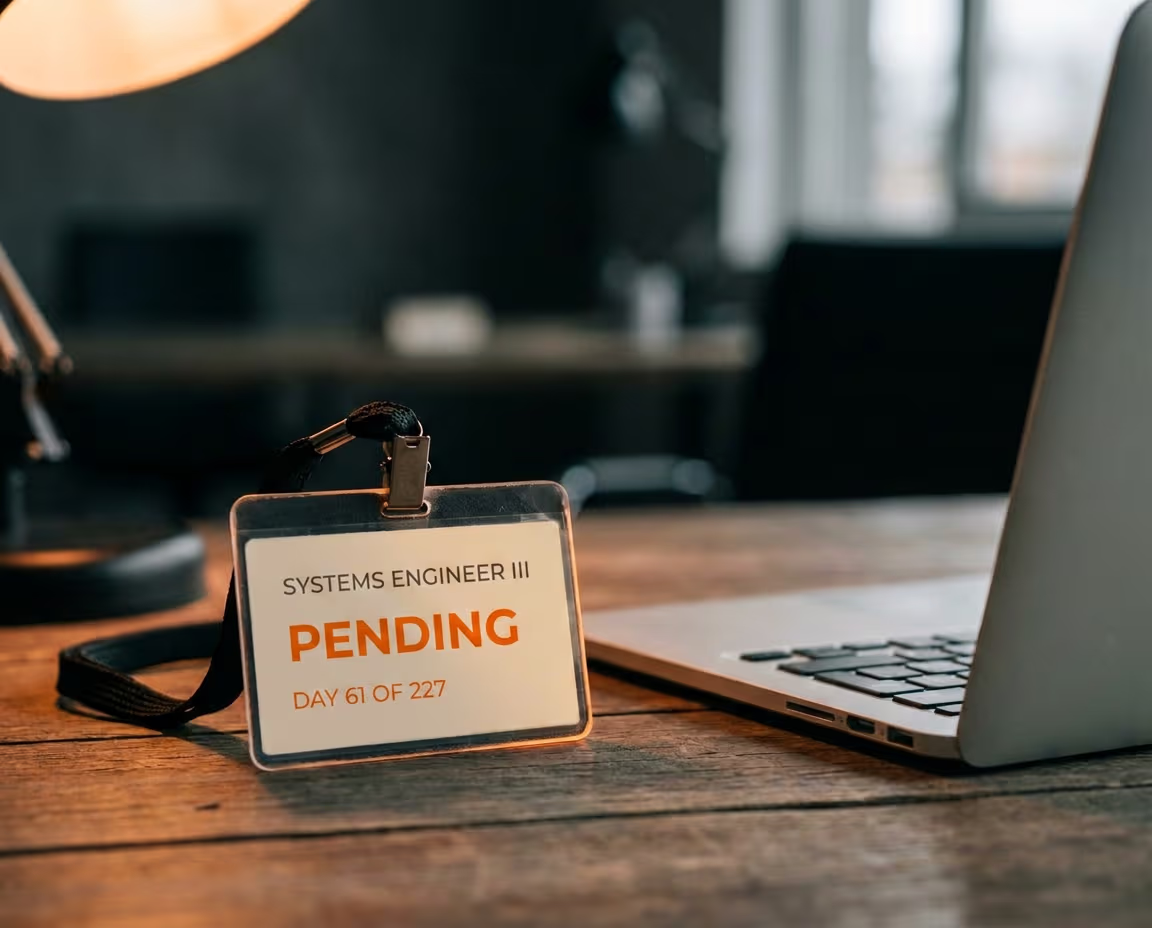
Hiring Is Getting Harder in GovCon, and Here's What It's Costing Contractors
Intro for the blog page A bad hire in GovCon doesn't cost you a salary. It costs you a CPARS rating, and CPARS follows you into the next recompete. Here's how one screening decision reaches an award you haven't bid yet.